INQUISITION INSIGHT
A Deep Dive into KL’s Pasar Seni

Articles
A Deep Dive into KL’s Pasar Seni
Not Hidden but Forgotten:
The rising issue of homelessness at Central Market
By: Dania Zulaikha, Adam Aznijar, Kamalin Huda and Ahmad Faiz
KUALA LUMPUR: Behind the captivating beauty of culture and art swarming at Central Market, there is a darkside to it - the dramatic rising victims of homelessness.
In the wake of a persistent and escalating homelessness crisis, the urgent need for solutions as the number of individuals experiencing homelessness continues to rise especially in the streets of Central Market.
In Malaysia, the Ministry of Women, Family, and Community Development (MWFCD) holds responsibility for addressing homelessness, while the oversight of enforcement falls under the purview of the Social Welfare Department (SWD).
In 2014, this population of homelessness was estimated at only 600 people on the streets however, in 2016, Dewan Bandaraya Kuala Lumpur reported that the number of homeless persons had tripled.
Since the Covid pandemic, homelessness has grown into a nationwide problem affecting over 20-30% of city inhabitants in Malaysia.

There is no concrete data to base the statistics of the accurate number to it, though a survey from DBKL back in 2016 estimated a close number of 1,500-2,000 homeless victims on the streets of Kuala Lumpur.
The rough estimated numbers of victims continuously strolling around the streets at Central Market and sleeping by the roads is almost hitting 90-100 individuals per day.
The root causes of homelessness can be contributed from, following the poor socioeconomic situations accompanied by the extremely weak, at times unfair welfare system in the country.
Like many other rapidly urbanising cities, Kuala Lumpur faces a shortage of affordable housing. The rising cost of living and property prices can make it difficult for low-income individuals to secure stable housing, leading to homelessness.
Economic factors, such as unemployment and underemployment, contribute significantly to homelessness.

A homeless man is seen sleeping on the streets of Central Market, Kuala Lumpur.
Kechara Soup Kitchen:
Views on the Central Market’s homelessness issue
Non-governmental organisations (NGOs) and community-driven initiatives play a crucial role in supporting the homeless population.
Countless NGOs have been formed along the last few decades in bettering the homelessness subject in Malaysia, as the awareness to helping these victims have not been taken as a serious concern to many.
Kechara Soup Kitchen (KSK), one of the largest soup kitchen communities specialising in providing service and help for the homelessness, distinguishes it from other NGOs by having various programs in distributing food packages, clothes, and providing social welfare.
Nurul Atiqah, the Public Relations representative from KSK says that all the products and resources given to the company are all under complete sponsorships.
“One of the NGOs aims in 2024 is to expand its partnerships with hypermarkets and increase the number of beneficiaries, benefiting the masses.
When questioning the specialty of their services, Atiqah adds that the company does not merely focus on distributing meal packages.
“I personally believe what makes our company special is that not only do we provide meals, we also provide many services such as giving fresh produce from partner hypermarkets and redistributing them to registered families or charity homes,
“We also bring our clients to hospital checkups, clinic appointments and so many more.”

Nurul Atiqah, Public Relations representative from KSK.
Atiqah adds that the average number of foods they give out at Central Market reaches up to 90-100 pax a day.
Based on estimated data from KSK’s observation, the demographics for the homeless victims on the streets are roughly 80%, ranging from 30-50 years old.
“For the race demographics, it’s quite tough to put an accurate number, but mostly Indians and foreigners are seen on the streets in Central Market,”
Unfortunately, we were not allowed to attach the data KSK keeps as they are strictly confidential and personal information of their clients are included in them as well.
“Usually during our night shifts at Central Market, we only give out food packages but if our clients requests for other necessities such as clothes we will distribute them accordingly.
In 2020, Kuala Lumpur City Hall (DBKL) conducted an operation to gather 71 individuals from 18 different countries who were found on the streets.
Atiqah states that the statistics of the victims in Central Market rises to their top 3 highest number of homeless victims in their record alongside Medan Tuanku and Jalan Imbi.
Walking around and discovering the depressing streets in Central Market, coming across foreigners is no surprise. Most of them were friendly with one another and showed no hints of violence tendency.
Atiqah adds that when she did visit the Central Market area to distribute the meal sets, everyone cooperated well and had already recognised the team from KSK which frequently visited them.
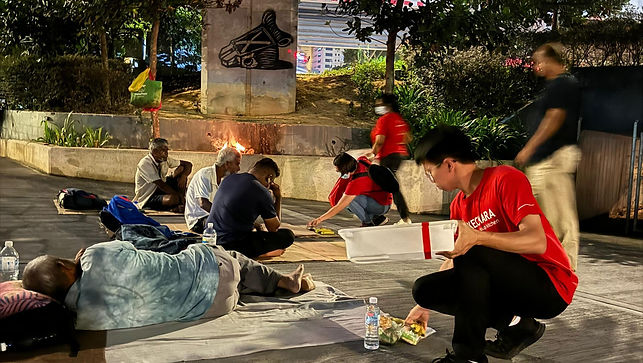
Distributing food packages at Central Market (Source: Kechara Soup Kitchen)

Provision of Kindness
Whilst walking around the streets, our team came across a kind family of four who were distributing meal packages to the homeless people.
In respect of them staying anonymous for the sake of not getting recognition, no picture and audio would be attached.
Farid (not real name) states that his family has been providing meals for the homeless victims since the COVID-19 crisis as they acknowledged families losing jobs and houses due to the pandemic.
Rapid urbanisation and gentrification can displace vulnerable populations. As the rising city of Kuala Lumpur develops and undergoes transformation, the cost of living may rise, pushing low-income residents out of their homes.
“It’s saddening to think about the heartbreaking condition of these victims, especially the individuals facing legal challenges which end up with them losing their job and a place to stay.”
Preventing the issue of homelessness is challenging, but it can be mitigated. The homeless population should be treated with dignity and courtesy.
Those who are willing and able to seek assistance should have access to appropriate support systems, including rebuilding their self-esteem, addressing mental health concerns, acquiring new skills and employment opportunities, and joining supportive networks, among other measures.